
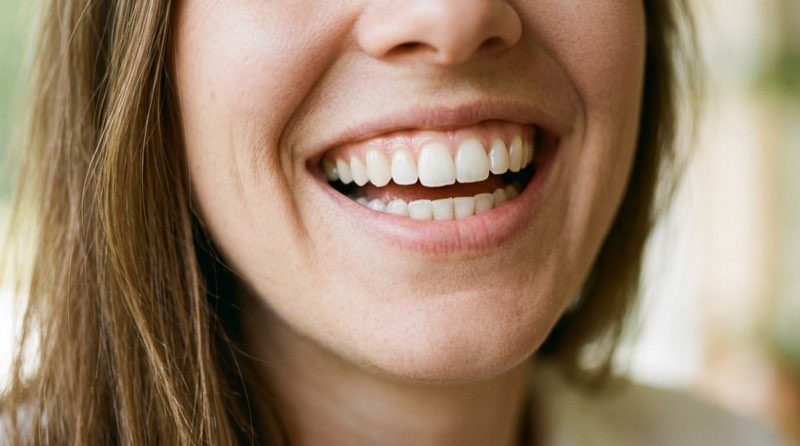
Some smile designs look artificial when they follow one uniform visual rule—very white, identical, extremely symmetrical teeth—without considering the person’s face, lips, gums, bite, and natural dental variation. At Clínica DrDiente Roma Norte, a proper evaluation should begin with those relationships rather than with a preset look. A natural-looking result is not about making every tooth match perfectly; it is about making the smile feel coherent when you speak, rest, and smile.
This article is educational and cannot determine whether any treatment is appropriate for you. A dental professional must evaluate your individual oral health, bite, and goals before recommending a procedure.
Why a smile design can look artificial
Teeth are only one part of a smile. Published dental-esthetics evaluations include the smile line, lips, visible teeth and gums, smile width, gum contour, midline, tooth inclination, and tooth proportions. When one of these relationships is overlooked, even teeth that look bright or straight on their own may not blend naturally with the whole face. PubMed’s review of dentofacial esthetics describes these interdependent elements.
Think of a smile like a tailored jacket. The fabric may be excellent, but if the shoulders, sleeves, and length do not relate to the person wearing it, the result can feel off. In the same way, a beautiful tooth shape in isolation may not suit a particular lip line, facial proportions, or way of smiling.
Natural does not mean identical. Natural teeth commonly show small differences in shape, texture, edge position, and light reflection. That variation is not a defect to erase automatically. A systematic review found substantial variation in natural tooth proportions and did not identify one mathematical formula that reliably predicts an esthetically satisfying result. Read the systematic review on mathematical tooth proportions.
The next reasonable question is whether choosing a “perfect” proportion solves the problem. It does not necessarily. Measurements can inform planning, but they are tools, not a universal recipe. The important step is to use them alongside clinical examination and a conversation about what looks balanced for the individual.
Roma Norte and CDMX: why an in-person evaluation matters
A local evaluation gives you room to discuss a smile in context instead of selecting an image or a single shade from a screen. For people in Roma Norte and nearby areas of CDMX, Clínica DrDiente Roma Norte is located at Monterrey 147, Roma Norte, Cuauhtémoc, 06700 CDMX. You can request a visit through Contact or learn the local location details at Dentist in Roma Norte. Requests are not appointment confirmations.
During a consultation, the professional may assess the health of teeth and gums, the bite, existing restorations, the amount of tooth and gum shown when smiling, and the objectives that matter to you. This matters because veneers are not merely a cosmetic overlay. According to the American Dental Association’s MouthHealthy overview of veneers, they can involve removal of enamel and treatment is not reversible; veneers may also chip, wear, or come off.
That is why a healthy starting point is valuable. Cavities or periodontal disease should not be treated as background details when considering a cosmetic restoration. The ADA notes that placing veneers over decay or gum disease can worsen existing problems, and decay can still develop around or below a restoration. Source: ADA MouthHealthy.
There is a useful distinction here: a design can be visually ambitious and still be clinically unsuitable at a particular moment. Addressing health or bite concerns first is not a detour from esthetics. It can be part of making a result more stable and more believable over time.
Details that influence whether a smile feels natural
Color is often the first feature people notice, yet “whiter” is not automatically “more natural.” The ADA describes selecting a shade that blends with natural teeth. A shade that is too bright for a person’s surrounding teeth, skin tone, or preferred level of subtlety may draw attention to the restoration instead of the smile. ADA MouthHealthy: Veneers.
Shape matters as well. Very flat edges, repeated outlines, or overly uniform corners can create a manufactured impression. This does not mean that every smile needs obvious irregularity. It means small decisions about contours, surface texture, translucency, and the relationship between neighboring teeth deserve individualized discussion.
- Smile line: how the upper teeth relate to the lower lip while smiling.
- Gum display and contour: how much gum is visible and how the gums frame the teeth.
- Midline and inclination: how the front teeth relate to facial features and to each other.
- Smile width: how many teeth show from the front and at the sides.
These are not a checklist for self-diagnosis. They are reasons a photo alone cannot settle the answer. The published review of dentofacial esthetics places these factors together because a smile changes across facial expressions, not just in one posed image. PubMed: dentofacial esthetics review.
Here is the point that is easy to miss: the goal is not to copy an abstract ideal. It is to decide, with appropriate clinical guidance, whether the proposed changes respect your oral condition and your own idea of a believable smile.
What to ask during a smile-design consultation
A thoughtful consultation should make space for questions. You do not need technical vocabulary to participate well; plain questions can reveal how planning connects to your priorities and health. Consider bringing a few images only as conversation starters, not as a promise that the same result suits every mouth.
- What features of my teeth, gums, lips, and bite are relevant to this plan?
- Are there cavities, gum concerns, or bite issues that should be addressed before a cosmetic procedure?
- What changes are proposed to color, shape, length, or alignment, and why?
- What are the limits, maintenance needs, and possible reasons a restoration could need repair or replacement?
Ask also what is irreversible. Dental materials function in a demanding environment that includes chewing forces, saliva, bacteria, pH changes, and temperature changes. They can degrade and may need repair or replacement. NIDCR’s Dental Materials Fact Sheet explains these general conditions. It also notes that repeated replacement of restorations can increase the risk of tooth loss because additional natural structure is removed with each replacement.
This is not meant to create alarm. It is meant to support an informed conversation before choosing an elective, potentially irreversible treatment. A useful plan explains both the aesthetic aim and the practical tradeoffs.
Frequently asked questions about artificial-looking smile designs
Does a brighter shade always look more natural?
No. A natural appearance is not defined by whiteness alone. Shade selection can be considered together with the natural teeth and the overall smile. The ADA notes that veneer color is selected to match natural teeth. ADA MouthHealthy: Veneers.
Is perfect symmetry always the goal?
No. Symmetry can be one consideration, but the available evidence does not support a single universal proportion or formula that guarantees an attractive, natural-looking smile. Natural dentitions vary considerably. PubMed systematic review.
Can veneers look natural?
They can be planned to look natural when color, shape, and fit are individualized. The ADA explains that porcelain veneers are custom-made, while composite veneers are sculpted and polished. The appropriate option and appearance depend on the person and the clinical assessment. ADA MouthHealthy: Veneers.
Why should gums and bite be considered before cosmetic work?
Because a smile is more than the visible front surface of teeth. Gum health, tooth condition, and bite can affect whether a cosmetic treatment is appropriate and how it functions. The ADA cautions that existing decay or gum disease can be aggravated if veneers are placed without addressing those conditions. ADA MouthHealthy: Veneers.
Can a restoration change over time?
Yes. Restorative materials are exposed to everyday chemical, biological, and physical forces and may need repair or replacement. Individual longevity cannot be predicted from general information alone. NIDCR Dental Materials Fact Sheet.
How and where can I request an evaluation in Roma Norte?
You may request an evaluation with Clínica DrDiente Roma Norte through the contact page or the Roma Norte dentist page. The clinic is at Monterrey 147, Roma Norte, Cuauhtémoc, 06700 CDMX, and its listed hours are Monday through Saturday, 09:00–18:00; it is closed Sundays. A request does not confirm an appointment. You may also call +52 56 1016 7727 to ask about availability.
When to request an evaluation
Request an evaluation before committing to a cosmetic treatment if you are concerned that a proposed look feels too uniform, if you have gum bleeding or discomfort, if you know you have cavities or bite concerns, or if you want to understand the irreversible aspects of veneers. The sources above support evaluating oral health and the full smile context rather than treating color or symmetry as the only variables.
A smile design need not look artificial simply because it is noticeable. The key question is whether its choices are individualized, clinically appropriate, and understandable to you. If you are in Roma Norte or CDMX and want to discuss that question, request a consultation through Clínica DrDiente Roma Norte’s contact page. Bring your goals and questions; the professional evaluation is where a personal recommendation belongs.

Information from Clínica DrDiente
Aesthetic Dentistry & Oral Rehabilitation · COFEPRIS 2409132002A00145
This content is informational and is not a substitute for professional dental advice. Book an assessment for a personalized diagnosis.